


Gepubliceerd op 16 apr 2024
Private equity has experienced strong growth in the past decades, with a record amount of capital raised and, on average, high returns. Meanwhile, the current economic climate has become a lot more uncertain and there is even talk of a recession. For many investors, an entirely justified question arises: how do private equity funds perform in times of economic crisis?
Private equity outperforms the stock market
In the past few years, this question has come up frequently in various studies drawing comparisons with the stock market. Since its great rise in the 1980s, the sector has faced a number of crises, and several things stand out:
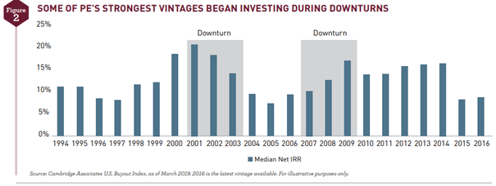
- During previous crises, private equity as an investment class has historically outperformed the stock markets. In the period from 2000 to 2016, it achieved a higher annual average of 4.4% compared to the stock market. This contrast tends to increase during economic downturns. Several data providers show that the best returns are achieved by vintage1 funds from the year following the Dotcom crash (2001) and the financial crisis (2008 to 2009).
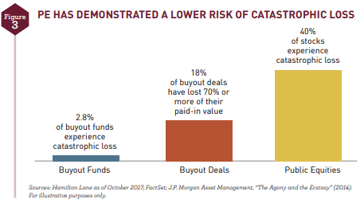
- Private equity investments are less sensitive to value fluctuations and have lower volatility during a crisis. Research by Hamilton Lane and J.P. Morgan compares the losses in private equity to the Russell 3000 index during the period 1980 to 2014. This showed that 40% of publicly registered shares in the United States experienced a catastrophic loss of more than 70% compared to the peak value. By comparison, less than three in a hundred private equity funds suffered similar losses during this same period.
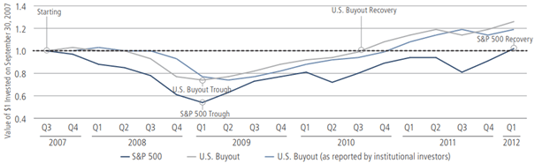
- Recent research by Neuberger Berman shows that private equity investments recover from a financial crisis quicker, as illustrated in the graph below.
What are the reasons why private equity endures recessions relatively well?
- Active management and hands-on approach: PE funds are actively involved in the management of their portfolio companies. Established funds often have dedicated value creation teams. Portfolio companies are supported in improving operational processes, receiving strategic advice or renegotiating loans during economic decline. Research by McKinsey shows that funds focusing on active management have performed relatively well during recent crises.
- Better access to capital and flexibility: Research shows that private equity portfolio companies have better access to capital and greater flexibility in allocating financial resources. This is often a decisive factor. The probability of a catastrophic loss of more than 70% is about twice as low for a company backed by a PE fund compared to a listed company. In addition, PE-backed companies were better able to increase growth investments during the financial crisis.
- Liquidity and long-term perspective: Private equity investments are not easily tradable and are inherently long-term. This prevents investors from selling in panic during downturns. While this may seem like a disadvantage, it actually helps investors maintain a long-term perspective and avoid short-term decisions driven by market volatility.


